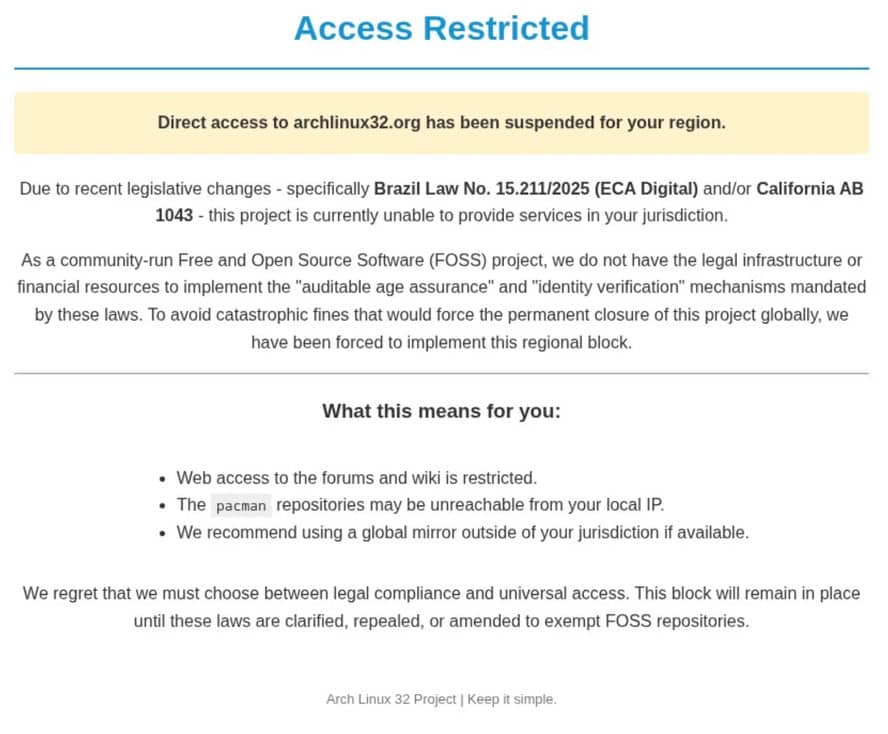
The Ageless Linux project launches a Debian-based system designed to test how new age verification laws could affect Linux distributions and open-source software.
Right off the bat, one thing needs to be clear: Ageless Linux, based on Debian, is not a traditional distribution. It is just a minor modification applied to an existing Debian installation.
Users install Debian, then run a script from the project that rebrands the system as Ageless Linux and applies a few changes reflecting the project’s legal position. That’s it.
There is more that explains many of the legal implications.
I am not sure I understand all the implications of this, and neither did the two commenters, but if it is against age identification I am all for it. I am not against age verification for kids on social media and some gaming sites, but this 'age verification' goes way to far and is way to intrusive and far reaching.
It seems to be a protest against government overreach. Yes it is not needed, but I get the point of it. The California law is way to intrusive and complicated as it is currently written.
So ... If I run an OS (i.e. UbuntuMATE) on my desktop, and I intended to have family members ...
[scenario 1] access it via household private LAN, would I need to comply with such laws on my Desktop computer?
[scenario 2] access it via remote connection to the household private LAN, via encrypted tunnel, would I need to comply with such laws on my Desktop computer?
It's says it could apply to all open software platforms and software repositories. That is ridiculous and intrusive. It seems to be government spying on people rather than protecting children. It is certainly government overreach, using a sludge hammer to accomplish what a tack hammer could do.
It's too vague to seriously be considered as a law. I guess compiling MS-DOS after 2027 is illegal in California?! That's a "general purpose OS" with no concept of users.
If they reword it so it targets "consumer devices" and "commercial" OSes - then the law would make more sense. But right now, it's overreaching:
Operating System Providers: An operating system provider is a person or entity that develops, licenses, or controls the operating system software on a computer, mobile device, or any other general-purpose computing device.
No, the article is specifically about open source platforms not the law, which would apply to everyone that is a person or entity that develops, licenses, or controls the operating system software on a computer, mobile device, or any other general-purpose computing device.
The main purpose of the law is suppose to be protecting children from addictive or harmful platforms, mostly social media and gaming sites.
Australia has been in the news for this same thing.
Australia has implemented laws requiring age verification for users accessing R-rated games and websites, as well as a ban on social media accounts for individuals under 16. These measures aim to protect children from harmful content and reduce their exposure to addictive online environments, with penalties for non-compliance reaching up to $49.5 million for companies that fail to enforce these regulations.
I get the age verification thing in general, but I guess I am still confused what that has to do with an OS. You would think the responsibilty would be on the app or website to manage age restrictions.
Maye the thought is if the OS verifies it then it makes it easier for the apps/sites to manage? Still, if it’s an open source OS, then there are hundreds of ways to get around that I would think.
I mean I understand the concept, but when does it become too much. We already have things like two factor authentication, authenticator apps, VPNs, etc… and most of us have to have a password manager to keep track of everything. Good forbid you forget a password and have to reset it, it could take 15 mins to make that happen. Now we have to authenticate our age? How long will that take? If you delete cookies, will you have to authenticate all over again?
Okay, so I know I am a slightly left of center Grumpy Old Man, but come on California… get over yourselves.
Article 1 defines the scope: it applies to "all information technology products or services directed at children and adolescents in Brazil or likely to be accessed by them."
and
Article 2, §2 excludes from scope "essential functionalities for the operation of the internet, such as open and common technical protocols and standards."
So it might be not as bad as presented and at least not as horrible as in California.
It is not the first time that California is mentioned when it comes down to bad ideas
"Object-oriented programming is an exceptionally bad idea which could only have originated in California"
The law just says there needs to exist a callable API which returns the users age bracket. Not even a specific age. There is no network mandate on said API. It can be a syscall, really. Also it has to be accessible to applications, so the most probable candidate for it would be inclusion to systemd (where it already has happened)
It seems perfectly reasonable to me to implement this law, and I have to ask myself if the people who decry this age verification law so much, how do they feel about CCPA/GDPR compliance? Try dealing with that, that is much more of a comprehensive headache to deal with (and not for the wrong reasons, people deserve to have privacy, people deserve to have autonomy)
A prompt at install asking the user’s age is not the beginning of an orwellian state, imo. It’s reasonable.
This project lists the distributions that are currently implementing age verification. Much depends on the adoption of systemd, which appears to be compromised.
Note that the same suspect developer, has made commits to various projects: